

Overview
With over 50 years of advanced ceramic expertise, Trans-Tech leads the industry in technical ceramic materials through its advanced materials product line. Leveraging in-house manufacturing capabilities, we deliver materials ranging from custom particle size distributions for thermal barrier coatings and fuel cells to machined precision components. As an independent material supplier, we build more than trusted materials — we build lasting relationships.
Trans-Tech’s Thermal and Environmental Barrier Coatings (TBCs and EBCs) set the industry standard for EB-PVD. Thanks to the material purity and uniform density, a controlled melt pool can be achieved with minimal eruptions and spits. This ensures high-quality results and superior performance in various applications.
Our Capabilities
With unmatched capabilities, we’re able to work on a number of needs and scales.
- In-house analysis
- Scanning electron microscope (SEM) with energy dispersive X-ray (EDAX) capability
- X-ray diffraction (XRD)
- X-ray fluorescence (XRF)
- Particle size distribution using laser light scattering
- Surface area analysis using BET method
- High temperature electrical conductivity (up to 1000 °C)
- Thermogravimetric analysis (TGA)
- Dilatometer for thermal expansion coefficient determination
- Optical microscopy
Production
Our high-volume, solid state reaction manufacturing process allows us to provide low-cost materials and large homogeneous batch sizes. Typical powders range in particle sizes (D50) below two microns and have surface areas up to eight m2/g. Standard forming methods can also be used to produce a variety of custom component shapes.
- Homogeneous lot sizes up to 3600 kgs
- Production capacity in excess of 500,000 kgs per year
- Urethane lined vibratory energy mills with ultra low wear media provide tight particle size distributions while minimizing media contamination
- Batch AND continuous kilns up to 1700 °C in a variety of atmospheres
Frequently Asked Questions
Advanced ceramics — also called technical ceramics or engineering ceramics — are inorganic, non-metallic materials engineered for specific performance characteristics like thermal stability, electrical properties, wear resistance, or biocompatibility. Unlike traditional ceramics used in pottery or construction, advanced ceramics are formulated from high-purity oxide powders and processed under tightly controlled conditions to achieve precise material properties.
The term “ceramics” refers to the material science — these are still inorganic compounds processed through powder preparation, forming, and high-temperature sintering. What makes them “advanced” is the precision of the formulation, the control of the manufacturing process, and the demanding applications they serve.
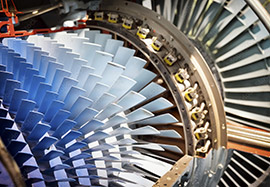
Advanced ceramics are everywhere critical systems need materials that can handle extreme conditions. Thermal barrier coatings protect turbine blades in jet engines and power plants. Dielectric ceramics enable wireless communication in every cellular base station. Ferrite ceramics make radar and GPS systems possible. Biocompatible ceramics support medical implants and devices. If a system operates at high temperatures, high frequencies, or in demanding environments, there’s likely an advanced ceramic inside it.
Aerospace (thermal barrier coatings for turbines), energy (solid oxide fuel cell materials), defense (radar absorbing materials, specialty powders), medical (biocompatible ceramics, RFID transponder materials), and wireless communications (dielectric and ferrite powders). We also serve customers in emerging applications like magnetodielectric antennas.
Yes. Our R&D chemistry lab can synthesize new compositions in small volumes for evaluation and then scale to production. We regularly develop proprietary formulations for customers with requirements that don’t fit our standard material portfolio.